In a groundbreaking medical milestone, veterinarians from Chulalongkorn University's Faculty of Veterinary Science have successfully performed Thailand's first pacemaker implantation in a cat, marking a new era in advanced veterinary cardiology. The procedure, led by Assoc. Prof. Dr. Anusak Kijtawornrat from the Department of Physiology, demonstrates Thailand's growing capacity in high-precision animal healthcare.

The patient, Pepsi, an eight-year-old domestic shorthair cat, had suffered frequent fainting spells—up to four times daily—caused by severe cardiac arrhythmia. After receiving the pacemaker, she made a full recovery and has since regained her normal strength, appetite, and playful personality.
Dr. Anusak explained that Pepsi's condition stemmed from a blockage of electrical signals between the heart's chambers, preventing blood from reaching the brain. Such arrhythmias are rare in cats, representing about 0.03% of feline cardiac cases and often occurring in older animals. The diagnosis was confirmed through 24-hour Holter monitoring, a more accurate tool than standard ECG testing.
Because of the cat's small anatomy, the surgery required extraordinary precision. Unlike dogs, where pacemaker leads can be inserted through a vein, cats have thinner heart walls—just two millimeters thick—making that method risky. The surgical team instead opened the chest cavity to attach the pacing lead directly to the heart's surface and connected it to a small generator implanted under the abdominal muscles. The one-hour operation involved a multidisciplinary team of cardiologists, surgeons, and anesthesiologists working in tandem.
The pacemaker, identical to human models but customized for feline use, costs around 59,000 baht in total, though Pepsi's device was a donated and sterilized unit. Post-surgery, she now visits the hospital every three months for follow-ups and continues to live a normal, active life.
Dr. Anusak emphasized that this success highlights Thailand's readiness to perform complex procedures at global standards. He encouraged pet owners to seek prompt veterinary care if their animals show signs of fainting or weakness and urged young veterinarians to continue learning and innovating:
"What once seemed impossible in Thailand is now achievable through dedication, collaboration, and continuous advancement."
Read the full article at https://www.chula.ac.th/en/highlight/271336/

 Repids: Turning Used Cooking Oil into Organic Insecticide - A Community Innovation from Chulalongkorn University
 "Every Day CO? Challenge": More Than a Game, A New Way of Learning
 Chula's CUSAT Team Achieves Global Space Milestone, Prepares to Launch CUSAT-1 Satellite in 2028
 "GULF Sparks Smiles" brings mobile dental services to Ayutthaya while empowering youth volunteers to help improve quality of life for Thai communities
 GIN-D Project by Chula - A Living Lab for Urban Well-Being and Sustainability
 Chulalongkorn University President Elected Head of Asian Universities Alliance
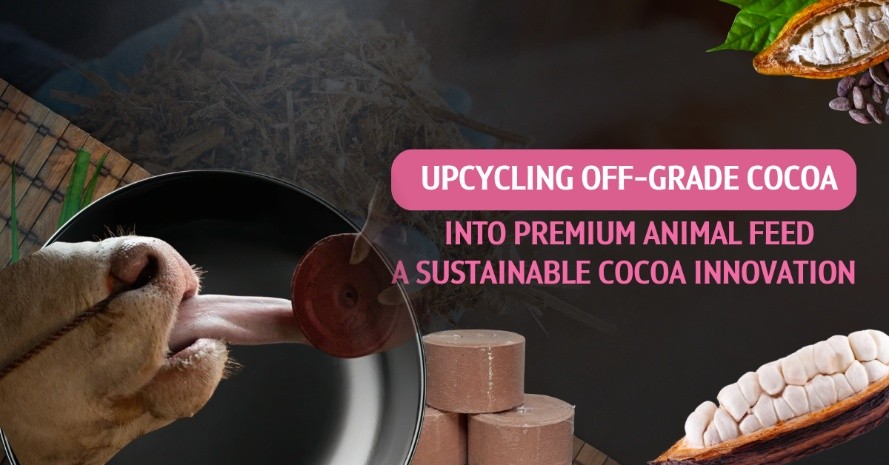 Happy Cows, Higher Income for Farmers with "Cocoa-Based Mineral Supplement" Chula Researchers Transform Low-Grade Cocoa into Premium Animal Feed
 Thailand's Top Universities Join Forces to Launch MC? GenEd, Redefining Higher Education for the AI Era
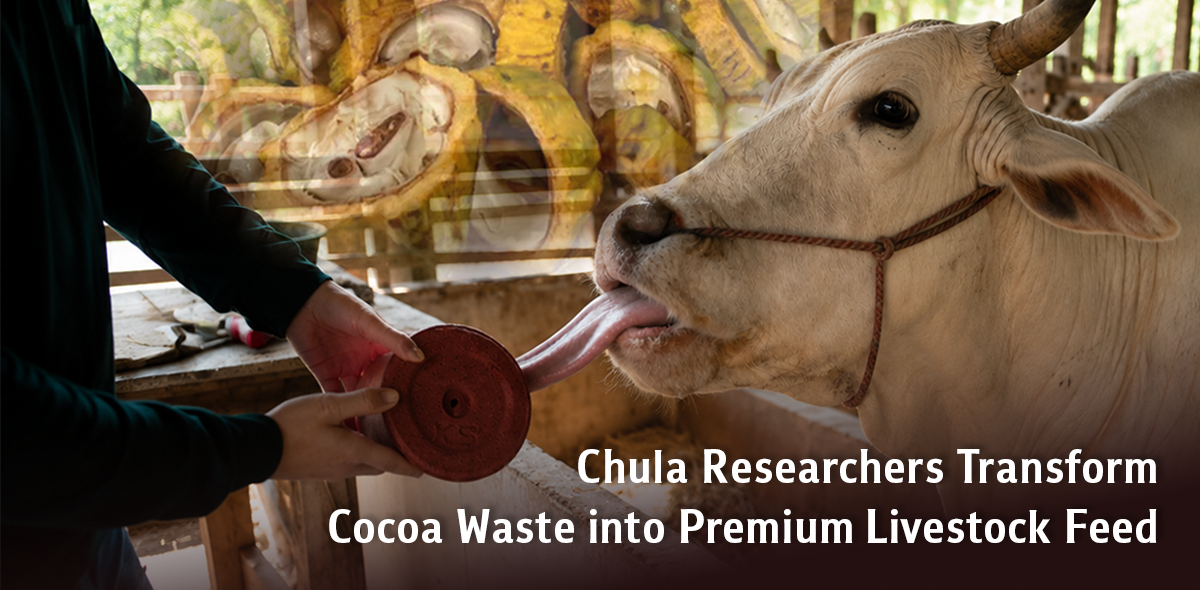 Chula Researchers Transform Cocoa Waste into Premium Livestock Feed