Chulalongkorn University researchers have developed a breakthrough recycling technology that transforms discarded fishing nets into high-value filament for 3D printing, offering a practical solution to marine waste while supporting a circular economy and coastal livelihoods.

The project is led by Dr. Nuttapol Risangud of the Petroleum and Petrochemical College, who was inspired by the growing volume of plastic waste along Thailand's coastlines—particularly abandoned fishing nets, or "ghost nets." These nets continue to trap marine life long after being discarded and eventually degrade into microplastics that enter the food chain, posing risks to ecosystems and human health.
In Thailand, discarded fishing nets are recycled but rarely turned into high-value products. This innovation converts them into usable engineering material. The research team launched a project to recycle nylon from fishing nets into filament suitable for Fused Deposition Modeling (FDM) 3D printing.
The production process involves several stages: collecting and cleaning the nets, shredding them into flakes, melting and compounding with additives, and finally extruding them into filament with a standard diameter of 1.75 mm. Converting the material into pellets before extrusion allows researchers to better control quality and consistency, addressing the variability of waste sources. The resulting filament can be used in a wide range of applications, from consumer goods to industrial prototyping. The team is particularly exploring its use in automotive components, such as motorcycle parts, which require materials that are both lightweight and durable. Beyond its technical potential, the innovation delivers environmental and socio-economic benefits.
The innovation creates demand for recycled nets, encouraging their collection and reducing marine pollution, while enabling fishing communities to increase their income through value-added processing. However, challenges remain, including maintaining consistent material quality, reducing the water demands of cleaning, and building confidence in recycled materials. The team is addressing these through improved formulations, more efficient processes, and close industry collaboration.
Currently in its early stages, the initiative aims to scale production, test the market, and eventually transfer knowledge to local communities. If successful, it could serve as a model for sustainable innovation—turning ocean waste into economic opportunity while helping restore marine ecosystems.
Read the full article at https://www.chula.ac.th/en/highlight/291271/
Media Contact:
Chula Communication Center
Email: [email protected]

 Repids: Turning Used Cooking Oil into Organic Insecticide - A Community Innovation from Chulalongkorn University
 "Every Day CO? Challenge": More Than a Game, A New Way of Learning
 Chula's CUSAT Team Achieves Global Space Milestone, Prepares to Launch CUSAT-1 Satellite in 2028
 "GULF Sparks Smiles" brings mobile dental services to Ayutthaya while empowering youth volunteers to help improve quality of life for Thai communities
 GIN-D Project by Chula - A Living Lab for Urban Well-Being and Sustainability
 Chulalongkorn University President Elected Head of Asian Universities Alliance
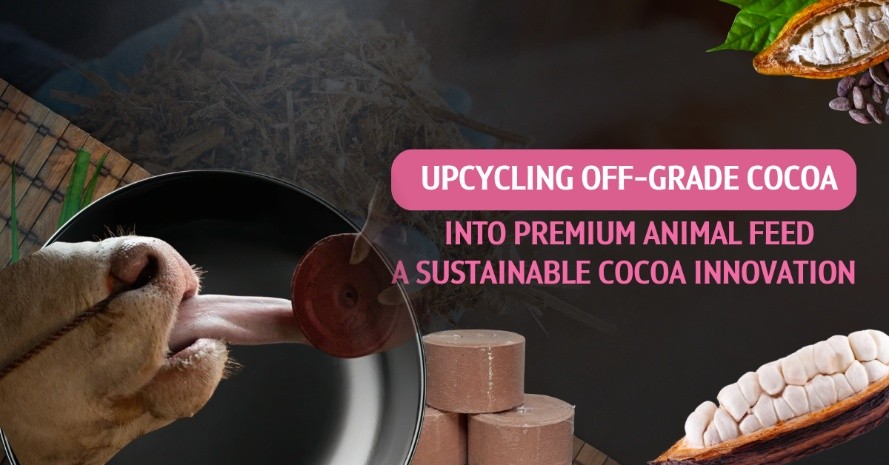 Happy Cows, Higher Income for Farmers with "Cocoa-Based Mineral Supplement" Chula Researchers Transform Low-Grade Cocoa into Premium Animal Feed
 Thailand's Top Universities Join Forces to Launch MC? GenEd, Redefining Higher Education for the AI Era
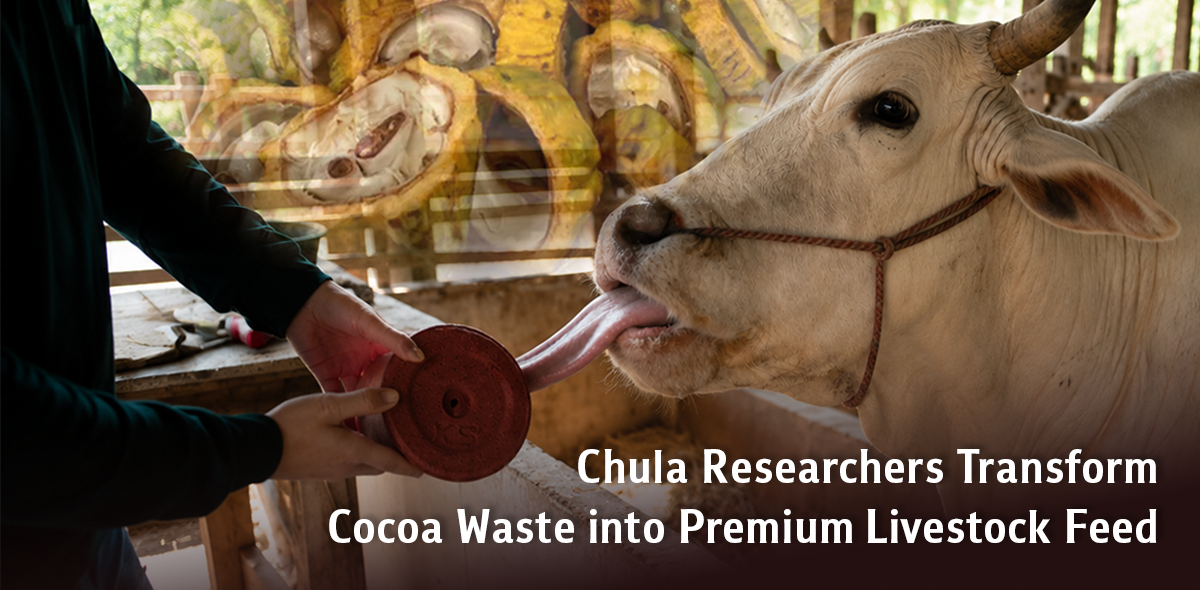 Chula Researchers Transform Cocoa Waste into Premium Livestock Feed