A student-led initiative at Chulalongkorn University is demonstrating how community-based action can provide a sustainable solution to urban stray animal management, combining veterinary care, public education, and digital tools to improve both animal welfare and public health.

Founded nine years ago, the Chulalongkorn University Veterinary Student Club for Animal Welfare runs the "JohnJud (Stray)" project, caring for stray dogs and cats across university faculties and surrounding areas, including Siam Square and Samyan Market. Its work spans sterilization, vaccination, medical treatment, adoption, and awareness campaigns, reflecting a holistic approach grounded in the "One Health" concept, which links human, animal, and environmental well-being.
A key feature of the project is the "JohnJud Map," an online platform that tracks more than 200 stray animals. The map provides detailed profiles, including photos, temperament, and vaccination status, helping students, staff, and the public interact safely with them. Color-coded markers indicate whether animals are friendly, shy, or should be approached with caution, reducing fear and uncertainty in daily encounters.
Central to the initiative is the internationally recognized Trap-Neuter-Return (TNR) method. Animals are captured, sterilized, vaccinated, and released back into their original territory, preventing new, unsterilized animals from moving in, and allowing populations to stabilize gradually over time. To support monitoring, sterilized animals are marked or microchipped, enabling tracking and follow-up care. To date, the project has sterilized more than 500 animals, demonstrating measurable impact.
Organizers stress that removing animals to shelters is not always a viable solution due to overcrowding and limited resources. Instead, the club prioritizes maintaining animals in familiar environments while improving their health and monitoring their numbers. For younger or more adaptable animals, adoption is encouraged, with careful screening and follow-up to ensure long-term care.
The initiative also relies heavily on collaboration. A network of volunteers, including students from multiple faculties and local "feeders," helps monitor animal health, report new arrivals, and coordinate care. Donations fund medical treatment and operations, while the Chula Faculty of Veterinary Science provides supervision for clinical procedures.
Beyond animal welfare, the program serves as a practical training ground for students, fostering professional skills, teamwork, and social responsibility. As urban stray populations remain a challenge, the JohnJud project offers a replicable model that emphasizes shared responsibility, community participation, and coexistence between people and animals.
Read more: https://www.chula.ac.th/en/highlight/303151/
Media Contact:
Chula Communication Center
Email: [email protected]

 Repids: Turning Used Cooking Oil into Organic Insecticide - A Community Innovation from Chulalongkorn University
 "Every Day CO? Challenge": More Than a Game, A New Way of Learning
 Chula's CUSAT Team Achieves Global Space Milestone, Prepares to Launch CUSAT-1 Satellite in 2028
 "GULF Sparks Smiles" brings mobile dental services to Ayutthaya while empowering youth volunteers to help improve quality of life for Thai communities
 GIN-D Project by Chula - A Living Lab for Urban Well-Being and Sustainability
 Chulalongkorn University President Elected Head of Asian Universities Alliance
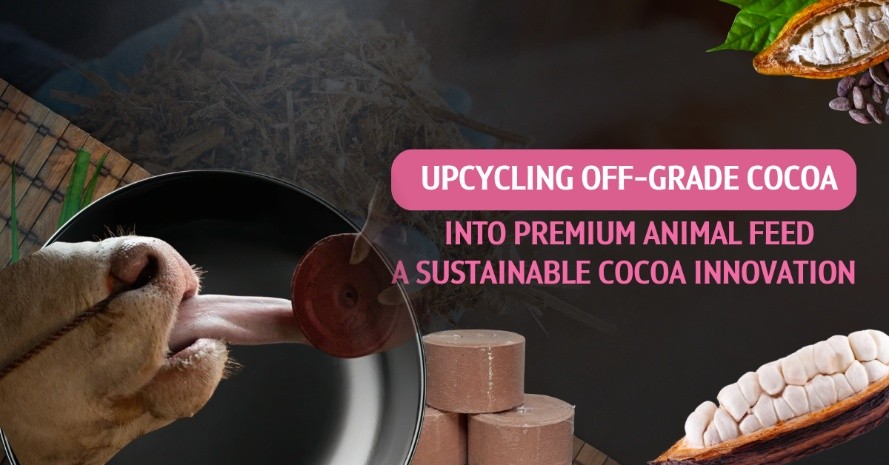 Happy Cows, Higher Income for Farmers with "Cocoa-Based Mineral Supplement" Chula Researchers Transform Low-Grade Cocoa into Premium Animal Feed
 Thailand's Top Universities Join Forces to Launch MC? GenEd, Redefining Higher Education for the AI Era
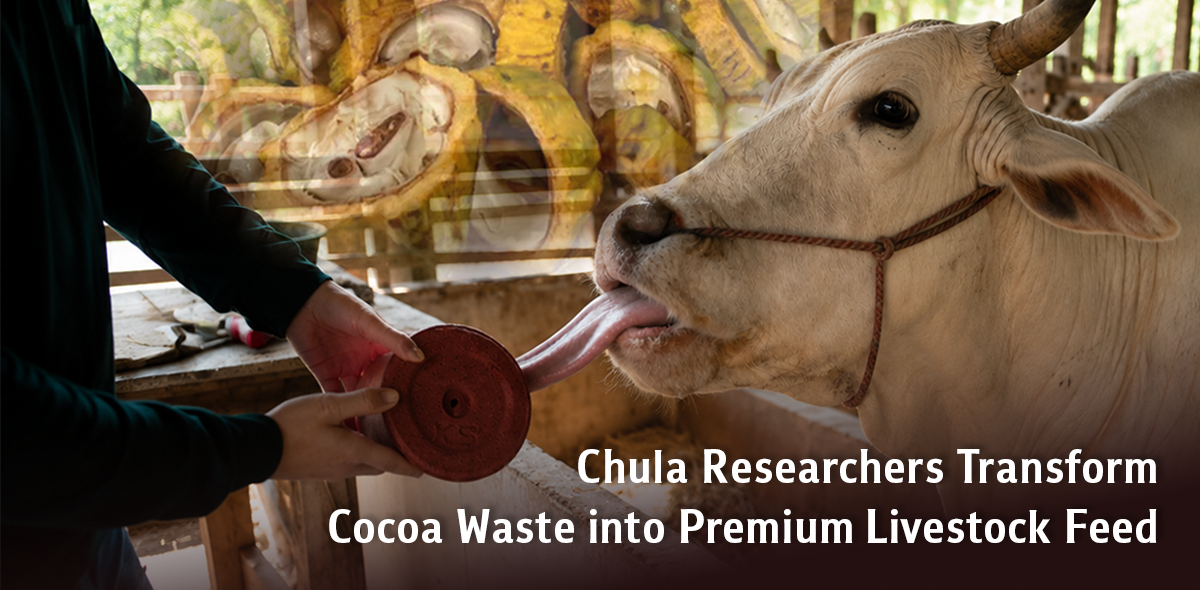 Chula Researchers Transform Cocoa Waste into Premium Livestock Feed