Chula Researchers Transform Cocoa Waste into Premium Livestock Feed
A researcher from Chulalongkorn University has developed an innovative "cocoa-based mineral supplement" that transforms low-grade cocoa and discarded cocoa husks into value-added livestock feed, helping farmers reduce costs, improve cattle health, and lower greenhouse gas emissions under a circular economy model.
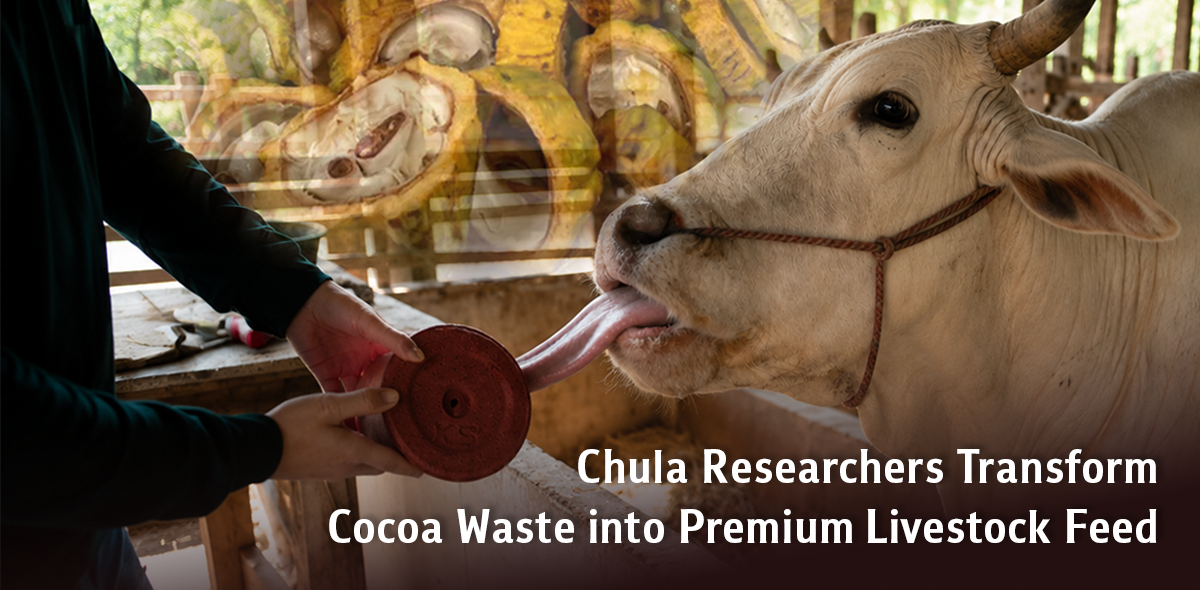
The project was led by Asst. Prof. Dr. Tansiphorn Na Nan, Acting Assistant Dean for Research and Academic Services at the Faculty of Integrated Agriculture and Director of the Innovation Center for Research and Development of Sustainable Cocoa Thailand (ISTC) in Nan province. The innovation emerged in response to worsening climate conditions that have caused cocoa crop losses of up to 80-90%, leaving farmers with large quantities of unsellable cocoa waste. At the same time, livestock farmers have faced rising feed costs during prolonged drought.
The research team created two forms of supplement: a compressed "lick block" for small farms and a powdered supplement for larger feed-mixing systems. Both products can incorporate cocoa waste as up to 30% of the ingredient formulation, creating a practical way to reduce agricultural waste while generating additional income for cocoa farmers.
According to the research, compounds naturally found in cocoa—including flavonoids, polyphenols, theobromine, and tannins—provide significant health benefits for livestock. Theobromine was found to improve cattle well-being, reduce inflammation, and enhance feed-to-meat conversion efficiency. In dairy cattle, testing showed that the supplement reduced somatic cell counts associated with mastitis by more than 70% and increased milk fat content by up to 15%.
Results in beef cattle were equally striking. Farmers who previously sold ordinary beef cattle for 20,000-30,000 baht per animal reported improved meat quality after using the supplement, with some cattle reaching premium A3 and A4 grades valued at more than 100,000 baht. Researchers also found that tannins in cocoa help suppress methane-producing bacteria in the rumen, reducing greenhouse gas emissions by up to 44% while redirecting energy toward muscle and fat production, improving marbling and meat quality.
Beyond cattle farming, the research is being expanded into poultry, goats, and shrimp farming, reinforcing the project's guiding principle that "every cocoa bean must have a purpose" and demonstrating how circular economy innovation can create sustainable value across multiple agricultural sectors.
For more information, contact the Faculty of Integrated Agriculture, Chulalongkorn University at Tel. 02 218 1243, or visit www.cusar.chula.ac.th.
Media Contact:
Chula Communication Center
Email: [email protected]