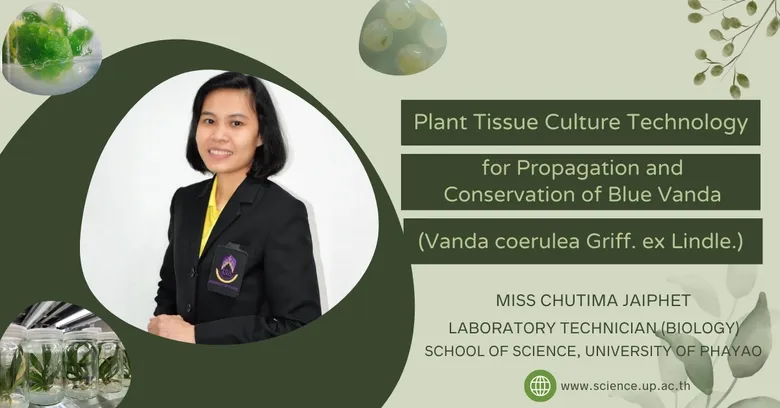
Plant Tissue Culture Technology for Propagation and Conservation of Blue Vanda (Vanda coerulea Griff. ex Lindle.)
In 1965, Professor Dr. Thavorn Vajrabhaya, B.S., from the Department of Botany at Chulalongkorn University, established plant tissue culture in Thailand. He was the first person in the country to use this method for experimenting with orchids, leading to Thailand's transition from an orchid importer to a major exporter worldwide. This research has since expanded to include other economic crops and higher education institutions across the country. Furthermore, government agencies focused on science have implemented plant tissue culture initiatives for various purposes, such as plant propagation, production of sterile seedlings, production of important substances, genetic conservation, and the exchange of plant varieties.
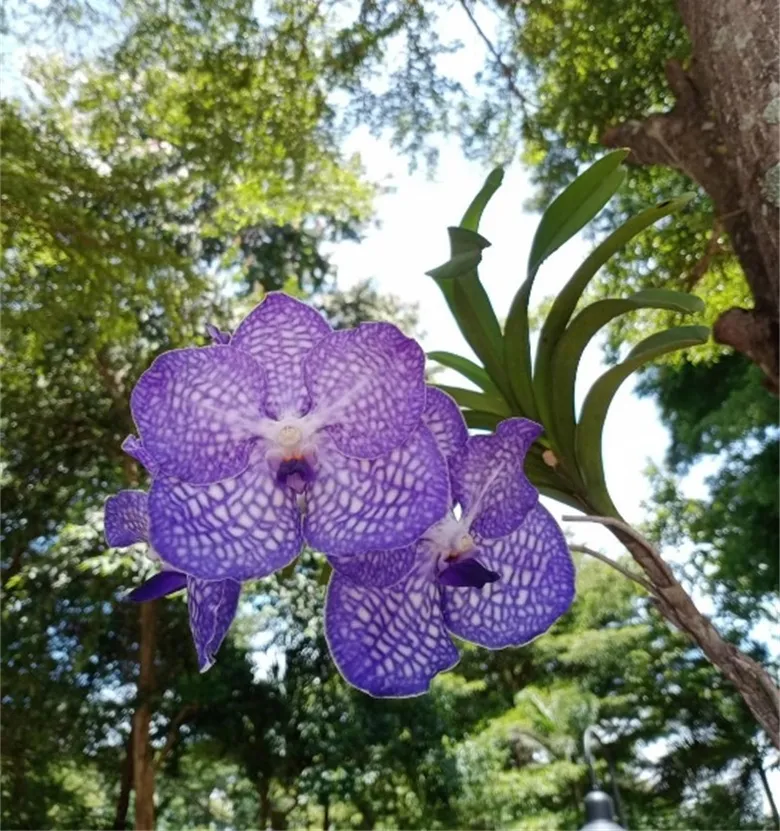
Fa Mui, also known as Blue Vanda, is the official flower of the University of Phayao. Scientifically named Vanda coerulea Griff. ex Lindle., this orchid boasts a range of light blue to blue-purple flowers with a striking dark blue grid pattern, making it exceptionally beautiful. It is often referred to as the 'Queen of the Vanda Orchids,' symbolizing the high-quality graduates produced by the University of Phayao, whose reputation has spread worldwide. Unfortunately, the popularity of the Blue Vanda has led to its heavy collection from the wild, resulting in a significant decline in its natural population and putting it at risk of extinction. Initially listed under the strict international trade controls of CITES (Convention on International Trade in Endangered Species of Wild Fauna and Flora) Appendix 1, which aimed to prevent its removal from the forest for sale, Thailand proposed in 2004 that the Blue Vanda be moved to Appendix 2 to allow for the development of commercial varieties.
The Plant Tissue Culture Research Laboratory, located at the School of Science at the University of Phayao, is dedicated to increasing the population of Blue Vanda orchids through the use of plant tissue culture techniques. The laboratory receives pod samples from the local Blue Vanda Orchid Conservation Village in Ban Pong Krai, Pongyaeng Subdistrict, Mae Rim District, and Chiang Mai Province. These samples are then cultivated under controlled laboratory conditions, with a focus on identifying the most effective nutrient formulas to promote healthy seed development. These cultivated plants serve as valuable teaching tools and also help to raise awareness about the importance of preserving the Blue Vanda orchid, which is the official flower of the university. In addition to this, the Plant Tissue Culture Research Laboratory is actively involved in collecting and propagating various native orchid species for future reintroduction into their natural habitats. These species include Dendrobium puchellum Roxb. ex Lindl, Dendrobium draconis Rchb.f., Dendrobium chrysotoxum, Dendrobium lindleyi Steud., Rhynchostylis gigantea Lindl. Ridl., Vanda lilacina Teijsm. & Binn., Cymbidium finlaysonianum, Grammatophyllum speciosum, and Anoectochilus reinwardti, among others.
References:
Chartisathian, J., (2004). Plant tissue culture: for agricultural applications. Bangkok: Printing House, The Agricultural Co-operatives Federation of Thailand Ltd.
THAI JUNIOR ENCYCLOPEDIA FOUNDATION by His Majesty King Bhumibol Adulyadej The Great. Saranukromthai for Youth, Volume 31, Issue 5, Plant Tissue Culture (E-book). Retrieved on 13th July 2024, from https://www.saranukromthai.or.th/sub/book/book.php?book=31&chap=5&page=t31-5-infodetail01.html
Hongpetch, A. (2002). Plant tissue culture. Bulletin of the Department of Medical Sciences, 50 (160), 1-4.