PwC Thailand projects a significant rise in the integration of generative AI (GenAI) in business strategies this year as businesses look for new ways to create value. To stay competitive, businesses should fully integrate AI into their operations and follow responsible AI practices for long-term success.

Vilaiporn Taweelappontong, Asia Pacific Financial Services Consulting Leader and Consulting Lead Partner at PwC Thailand, emphasises the transformative power of artificial intelligence (AI). Incorporating AI into organisational frameworks is no longer optional; it's a necessity for accelerating operations and maintaining a competitive edge.
"In 2025, GenAI will advance and utilised more seriously and widely to achieve business strategies. Last year, the sentiment towards GenAI in the Thai market was positive. We've seen many organisations integrate this technology across several areas, such as content creation, personalised marketing, customer support, games and entertainment development, and education," Vilaiporn said.
"In the private sector, AI technology adoption continues to increase within PwC and by our clients across various industries to enhance business efficiency. This includes using AI for coding, supporting customers with chatbots that interact with humans and handle complex queries, and upskilling and training employees through AI platforms tailored to their learning preferences," she said.
AI adoption among Thai businesses has risen to 17.8% from 15.2% in 2023, while 73.3% of organisations are preparing to use AI in the future, according to the AI Governance Center's (AIGC) 'AI Readiness Measurement 2024' report.
PwC predicts a transition from pursuing AI use cases to harnessing AI to achieve business strategies, as outlined in the firm's '2025 AI Business Predictions'. Although fundamental work processes will transform, humans will continue to play a crucial role in teaching and managing AI, benefiting from increased automation.
In the US, nearly half (49%) of technology leaders surveyed for PwC's Pulse Survey from October 2024 reported full AI integration into their company's core business strategy, and one-third said AI was fully embedded in their products and services.
AI use cases in 2025 Vilaiporn highlights six GenAI use cases with high potential:
- Advanced personalisation: GenAI will likely offer even more sophisticated personalisation, with AI systems capable of creating hyper-personalised content and experiences based on real-time data analysis. This includes potential integration with augmented reality (AR) and virtual reality (VR) for immersive, personalised environments.
- Greater collaboration with humans: GenAI tools will become more collaborative, working alongside humans in creative processes, offering suggestions and iterating on ideas in real-time, effectively acting as co-creators across various domains.
- Ethical and regulation frameworks: As GenAI becomes more pervasive, stronger ethical guidelines and regulations are likely to be developed to govern its use. These will focus on privacy, security and bias mitigation to ensure responsible deployment.
- Sustainability and environmental focus: The development of GenAI technologies might focus on sustainability, using AI to generate solutions for environmental issues. Examples are optimising resource management or designing eco-friendly products.
- Enhanced security applications: Another likely use case is improving cybersecurity measures, such as generating adaptive security protocols or simulating potential cyber threats for better preparedness.
- AI in the creative arts: Artists and creators are expected to use GenAI to push the boundaries of traditional art forms, leading to entirely new genres that fuse human creativity with machine-generated content.
Business must double down on 'responsible AI'
Businesses must remain vigilant about the risks associated with AI to build trust with consumers and stakeholders, Vilaiporn emphasises. PwC has collaborated with businesses across various industries to develop and implement a framework for responsible AI. The four main principles are:
- Ethical design and use: AI systems should be designed and used in ways that respect human rights and adhere to ethical standards. This includes ensuring fairness, transparency and accountability.
- Bias mitigation: Organisations should implement strategies to identify and mitigate biases in AI models. Diverse datasets, regular audits and bias detection tools must be used to ensure equitable outcomes.
- Data privacy and security: Protecting data privacy and ensuring robust security measures are critical. Organisations should comply with relevant data protection regulations and implement secure data handling practices.
- Governance and accountability: Clear governance structures for AI initiatives must be established. Defining roles and responsibilities and setting up oversight mechanisms are essential.
"Responsible AI governance is crucial for building trust and mitigating risks. Strong governance, whether through highly skilled internal audit teams or external experts, is essential for controlling AI usage and enhancing its potential to benefit digital transformation," Vilaiporn said.
The AIGC's 'AI Readiness Measurement 2024' reveals that only 16.5% of Thai organisations have put in place AI ethical practices, but 43.7% are planning to.

 PwC Thailand and Mahidol University sign MoU to strengthen academic collaboration and develop future-ready talent
 PwC: Thai CEOs' revenue confidence falls to three-year low amid economic and AI disruption
 Smart Spending ในยุคค่าครองชีพสูง: ใช้เงินอย่างไรให้ "คุ้มจริง"
 PwC Thailand honoured with 'Leading of People' award at Future Trends Awards 2026
 PwC Thailand urges organisations to accelerate responsible AI and strengthen governance
 Thai workforce faces financial strain, but hope emerges among AI users
 PwC Thailand volunteers unite for 'Revisit Khao Yai—Explore the Tangerine Trail' project
 PwC: Thai family businesses see double-digital sales growth drop amid economic and geopolitical volatility
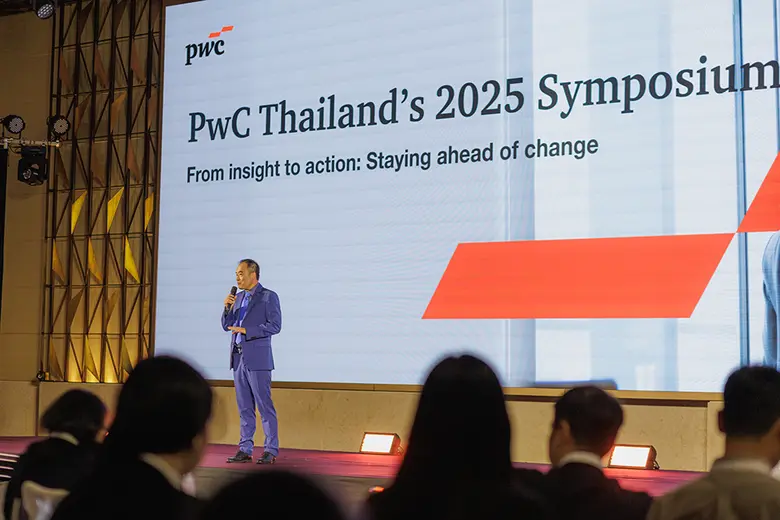 PwC Thailand hosts its annual symposium, highlighting the theme: 'From insight to action: Staying ahead of change'