Chulalongkorn University's Faculty of Medicine has developed ER-VIPE, a virtual emergency-room simulation platform designed to strengthen teamwork, communication, and critical-thinking skills among future healthcare professionals. Supported by the university's Second Century Fund (C2F) since 2020, the program enables students from five disciplines—medicine, nursing, pharmacy, radiologic technology, and medical technology—to train together through high-pressure emergency scenarios that mirror real clinical challenges.

ER-VIPE is integrated into the Interprofessional Collaboration for Patient Safety course held at the Chulalongkorn Healthcare Advanced Multi-Profession Simulation Center. Players assume different professional roles through avatars and work as a team to triage and treat diverse cases under strict time limits. Although game-based, the training emphasizes serious skill-building: leadership, clear communication, mutual support, and situational awareness, based on TeamSTEPPS—an internationally recognized framework for improving patient-safety outcomes.
Asst. Prof. Dr. Khuansiri Narajeenron, the creator of ER-VIPE, stresses that strong clinical skills alone are not enough. "If we don't communicate or see the bigger picture, medical errors will occur," she said, noting that collaborative thinking remains a global challenge in healthcare. Research from the program shows improved teamwork, reduced stress, better communication, and increased resilience among students who train with ER-VIPE.
The platform was developed through interdisciplinary collaboration, including Architecture, Engineering, and Communication Arts, to accurately map emergency-room workflows. ER-VIPE currently features three patented scenes: a COVID-era respiratory-failure case, cardiac ischemia requiring resuscitation, and a crowded ER scenario emphasizing patient flow, prioritization, and cross-disciplinary coordination. National-level gamers, pre-clinical students, and even administrators have been able to use the system after a brief orientation.
The training has expanded beyond undergraduates to include first-year medical residents, graduate students, and multidisciplinary hospital staff. The program has demonstrated significant benefits, including shifts from "silo thinking" to system-based thinking and measurable reductions in treatment errors. Interest has also grown among rural-doctor training programs, highlighting ER-VIPE's potential to support nationwide healthcare development.
A fourth scene—focused on accidents in older adults, including ethical considerations and AI-based soft-skill assessment—is now underway with support from the Chulalongkorn Innovation Fund. Expected to be completed this year, it will be the world's first simulation of its kind.
Ultimately, ER-VIPE aims to cultivate healthcare teams who communicate better, think together, and deliver safer, more effective care.
Read the full article at https://www.chula.ac.th/en/highlight/276022/

 Repids: Turning Used Cooking Oil into Organic Insecticide - A Community Innovation from Chulalongkorn University
 "Every Day CO? Challenge": More Than a Game, A New Way of Learning
 Chula's CUSAT Team Achieves Global Space Milestone, Prepares to Launch CUSAT-1 Satellite in 2028
 "GULF Sparks Smiles" brings mobile dental services to Ayutthaya while empowering youth volunteers to help improve quality of life for Thai communities
 GIN-D Project by Chula - A Living Lab for Urban Well-Being and Sustainability
 Chulalongkorn University President Elected Head of Asian Universities Alliance
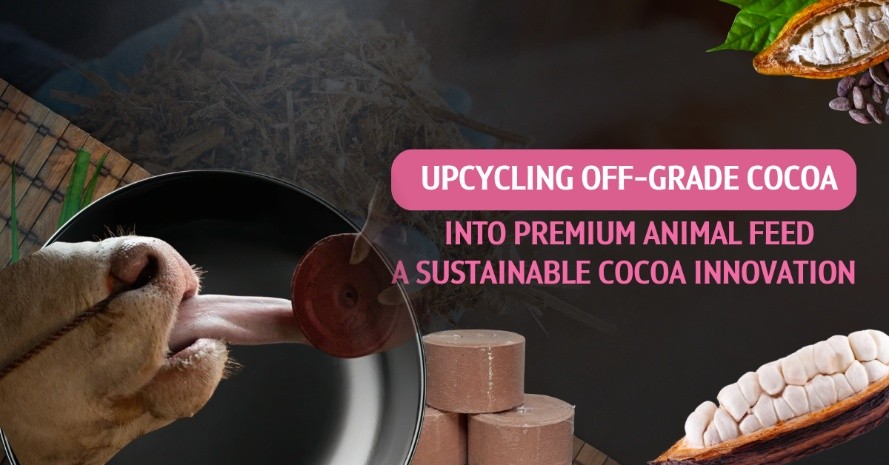 Happy Cows, Higher Income for Farmers with "Cocoa-Based Mineral Supplement" Chula Researchers Transform Low-Grade Cocoa into Premium Animal Feed
 Thailand's Top Universities Join Forces to Launch MC? GenEd, Redefining Higher Education for the AI Era
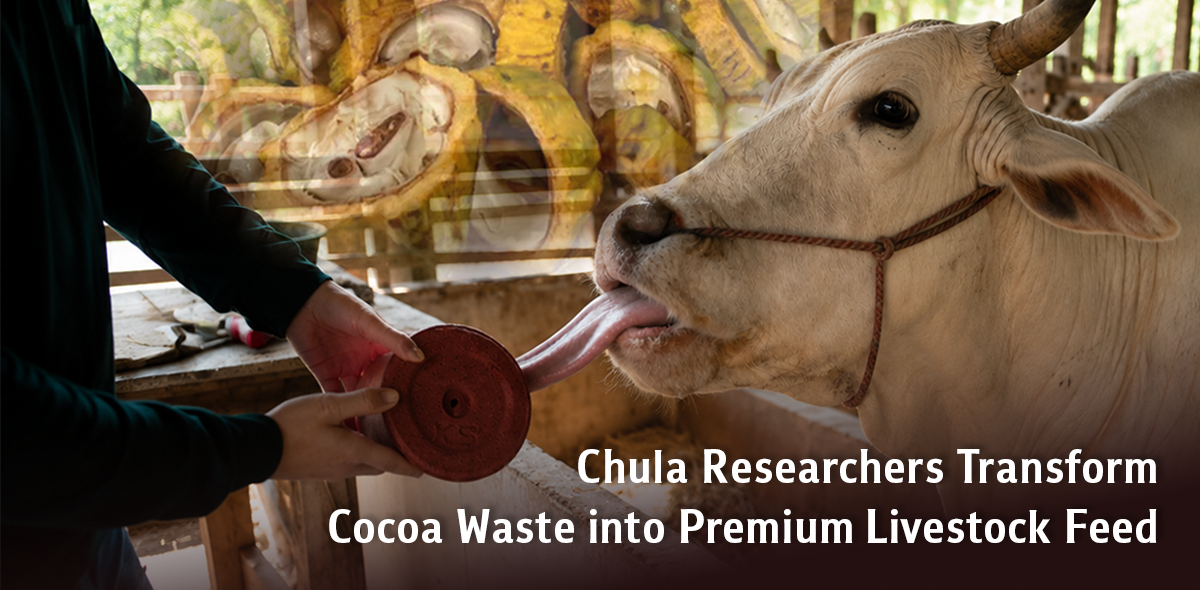 Chula Researchers Transform Cocoa Waste into Premium Livestock Feed